Vibecode Rescue: invoicemonk.com
A compliance-first e-invoicing platform that gives three different answers for how many jurisdictions it covers — 16, 18 and 30+ — on a single page. 56/100 — At Risk.
Invoicemonk issues structured, mandate-compliant e-invoices — ZATCA in Saudi Arabia, MyInvois in Malaysia, GST IRN in India, Peppol in the EU, FIRS in Nigeria, MTD in the UK, eTIMS in Kenya — with the cryptographic artefact each tax authority requires. Pro starts at $15 a month. There's an Android app, a free invoice generator that needs no account, and a blog that goes deep enough on Italian FatturaPA clearance to be genuinely useful.
It scored 56 out of 100. At Risk.
Observed on 2026-08-05 against a snapshot of the page, the shipped bundle, response headers, DNS, and the client-rendered legal pages. No account was created.
The positioning here is the sharpest in the batch. That's precisely why the next section matters.
Sixteen, eighteen, or thirty-plus
All three of these are on the homepage. One page, one scroll.
In the hero:
The global e-invoicing platform for small business. Mandate-compliant in 16 jurisdictions.
See the 16 live mandates →
A screen down, in the compliance section:
30+ supported jurisdictions
Tax-compliant invoicing across 30+ countries and jurisdictions
Trusted by freelancers, consultants, agencies, and small businesses invoicing across more than 30 countries.
And in the artefact section, under a heading about cryptographic signing:
Invoicemonk issues cryptographically signed structured invoices in every one of the 18 jurisdictions we cover, using the local artefact the tax authority requires.
Sixteen live mandates. Eighteen jurisdictions covered. Thirty-plus supported. There's a defensible taxonomy hiding in there — live e-invoicing mandates is a genuinely narrower thing than countries whose tax formatting we support, and 16 versus 30+ could be exactly that distinction, honestly drawn. But then 18 turns up in the middle, in the section that is specifically about the mandates, and the taxonomy collapses. Three numbers, each of them undefined.
The product's entire argument is that a generic invoicing tool gets your numbers wrong and Invoicemonk gets them right. Its own homepage quotes itself:
Your invoice isn't just a payment request. It's a legal document. We built Invoicemonk to treat it like one.
That's a good line. It's also the standard the page is now being held to, and the page is the artifact a buyer reads first. When the marketing copy about jurisdictional accuracy can't hold a jurisdiction count steady across three sections, the reasonable inference isn't that the product is wrong — it's that nobody proofreads the artifacts here, which is the exact failure the product sells against.
Every URL returns 200
$ curl -o /dev/null -sw '%{http_code}\n' https://invoicemonk.com/seams-audit-does-not-exist-20260805
200
The router answers everything with the app shell. /privacy, /terms, /refund, /security, and a path invented for this audit all return 200 with the same 19 KB document, and the real content appears only after the JavaScript executes.
The consequence is specific and worth stating. Any automated check that asks "does this site publish a privacy policy?" by fetching /privacy and looking at the status code passes — on a URL that serves no policy. So does the check for /terms. So does the check for a page that has never existed. Vendor security questionnaires, procurement scanners and link checkers all run exactly that test.
The actual policies do exist and they're client-routed at /privacy-policy and /terms-of-service. Which makes this a routing defect rather than a missing-document defect — a much cheaper fix, and a much better position than three other products in this batch.
The data controller is a brand
The privacy policy is real work: thirteen sections, legal bases, international transfers, a named Data Protection Officer at dpo@invoicemonk.com, and explicit provisions for the EU/EEA, UK, California, Brazil, Nigeria, Australia and Canada.
Then section 1:
Data Controller: For the purposes of the General Data Protection Regulation (GDPR) and other applicable data protection laws, Invoicemonk is the data controller responsible for your personal data.
Invoicemonk is a product name. Article 13 wants the identity of the controller — the legal person — and, where relevant, its representative and address. The site and both policies omit the company name, the registration number and the registered office. The document appoints a DPO and enumerates rights across seven jurisdictions while never saying which entity a data subject would be exercising those rights against.
For a platform that collects "tax identification numbers (TIN, VAT, GST), business registration details" and "bank account details for payouts", that's the wrong asymmetry: it knows exactly who its users are, incorporated and numbered, and its users don't know who it is.
The policy is also dated January 2025, which for a product shipping against mandates that move every quarter is worth a refresh on its own.
The browser talks to the database
https://skcxogeaerudoadluexz.supabase.co
eyJhbGciOiJIUzI1NiIsInR5cCI6IkpXVCJ9…
Supabase URL and anon key in the bundle, public by design, protected by row-level security that cannot be verified from outside. Unknown, 5.5 of 11.
The data class raises the stakes rather than the score: invoices carry counterparty names, addresses, tax numbers and amounts, and the product's own pitch is that these records are immutable and audit-ready. "Immutable" is a claim about write paths that a black-box run cannot see.
What it gets right
- The best free-tools funnel in the batch. A full invoice generator with tax fields, logo upload and PDF download, plus a payment-fee calculator and a freelancer rate calculator, all with no signup. That's a real acquisition loop.
-
Discoverability is excellent: a 93 KB sitemap, a proper
robots.txt, SEO 100, and a blog with substantive per-mandate technical writing — the SdI piece explains the Codice Destinatario and the ricevuta di consegna correctly. - The artefact list is specific and checkable: CSID for ZATCA, IRN for GST India and FIRS, UUID for MyInvois, Chave de Acesso for NF-e, XAdES for Peppol and MTD, ICP-Brasil A1 for Brazilian signing. Somebody who knows this domain wrote that.
- HSTS is present, and the bundle scan is otherwise clean.
- SPF is published and the domain receives mail; a DPO address exists and is reachable.
- Pricing is stated up front at $15, with an Android app in the Play store.
The engineering underneath
Five of six security headers are missing; HSTS is the only one set.
DMARC is p=none — monitor-only, blocking nothing — with reports routed to Brevo.
Lighthouse 12, desktop: performance 40, accessibility 87, best practices 78, SEO 100. 5.1 MB transferred, a 5-second largest contentful paint, 535 ms of blocking time. Accessibility failures include frame-title, label-content-name-mismatch and target-size — that last one meaning tap targets too small or too close together, on a product whose users are on phones in the field.
The score
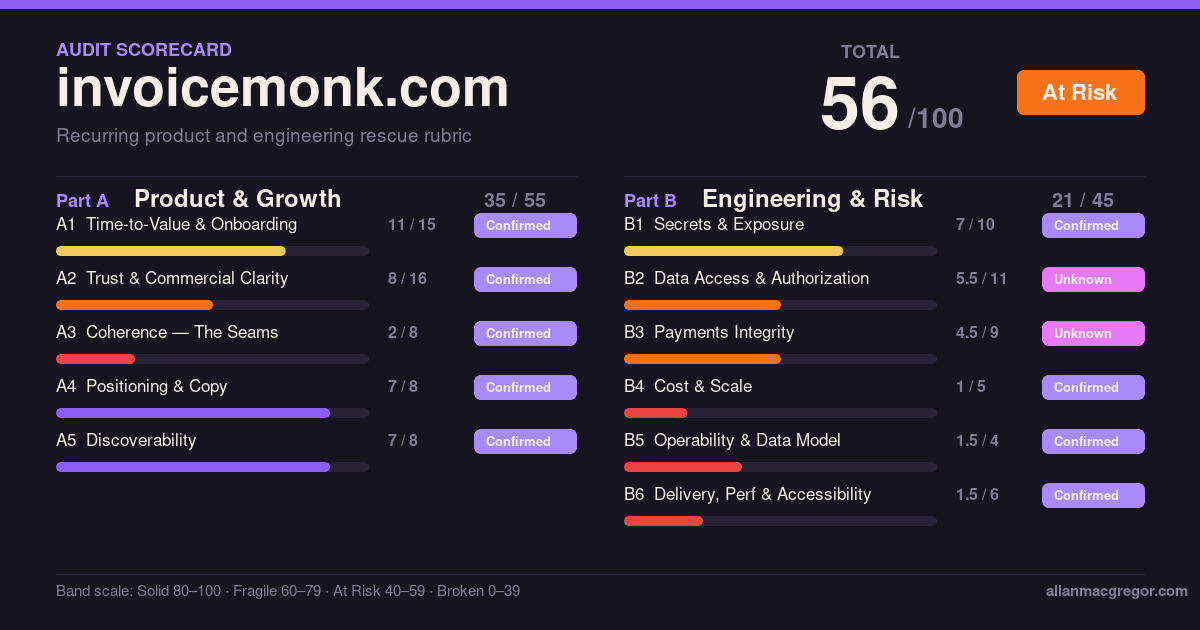
Part A at 35 of 55 is the second-highest in this batch — positioning, discoverability and time-to-value are all strong. Coherence at 2 of 8 is what pulls it down, and every point of that came from numbers disagreeing with each other on one page.
What I'd fix first
- Pick one jurisdiction taxonomy and define it. "16 live mandates, 30+ jurisdictions with tax-aware formatting" is a perfectly good sentence — write it once, use it everywhere, and delete the 18.
- Return 404 for paths that don't exist, and serve the policies at the URLs everyone's scanner will try.
- Name the legal entity in both policies, with a registered address. You are asking for users' registration numbers; publish yours.
- Get the homepage under 2 MB. Five megabytes and a 5-second paint on a product sold to people invoicing from phones in emerging markets is a conversion problem before it's a performance problem.
-
Move DMARC off
p=none, and add the five missing headers.
Disclosure
Findings went to the operator before this published. These audits are free and public; the paid version is a Code Health Check, and the rescue work after it is Track 03 on my services page.
Two dimensions scored Unknown and code access resolves both: whether row policies are enforced on the tables the browser is already querying, and whether "immutable invoice records" is enforced at the write path or by convention.
